
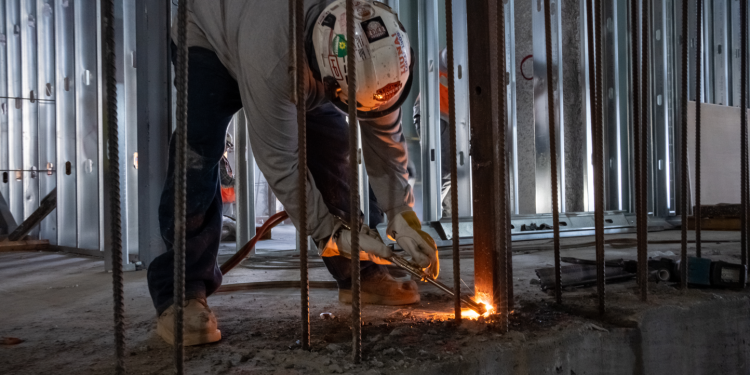
| General | Only trained and authorized personnel can perform welding operations. Welding leads and hoses must be kept out of passageways and access areas. Inspect all equipment before use for damage. Do not weld inside a confined space such as a vessel or tank without following our confined space procedures. Evaluate the materials to be welded or cut for hazards such as coatings and include controls in the AHA planning. |
| Fire Prevention | Hot work permits are required for work that produces a spark or flame. A fire watch must be assigned and used for all hot work activity producing a spark or flame. More than one fire watch may be required. The fire watch must stay in place at least 30 minutes after hot work is complete. Some projects may require an extended fire watch. Have a dedicated fire extinguisher within 30 ft of any welding burning or open flame work. Keep access clear. Make sure the fire extinguisher is rated at minimum 10-ABC. Remove all fire hazards in the vicinity where the hot work will take place. Do not work within 50 feet of combustible dust or where flammable liquids or materials are stored. |
| Personal Protective Equipment | Check with your supervisor for ventilation and respiratory protection requirements. Wear flame-resistant clothing. Do not wear high visibility vests while welding. Long sleeves are required. Be aware of openings like pockets or pant cuffs that can trap sparks and spatter. Use welding screens to protect other workers in the area. Welders shall use a welding helmet/hood that attaches to a helmet and use a filter shade appropriate to the work being performed. Wear safety glasses with side shield or under the welding helmet/hood to protect against debris ricochet under the helmet. Wear googles during other hot work operations. Refer to the Welding Operations Shade Number Chart to determine the correct shade number on the filter for hot work operations. |
| Welding Operation Shade Number Chart | ||
|---|---|---|
| Operation | Size | Shade # |
| Soldering | 2 | |
| Torch Brazing | 3 or 4 | |
| Light cutting | Up to 1 inch | 3 or 4 |
| Medium Cutting | 1 to 6 inches | 4 or 5 |
| Heavy cutting | 6 inches and over | 4 or 5 |
| Gas welding (light) | Up to 1/8 inch | 4 or 5 |
| Gas welding (medium) | 1/8 to 1/2 inch | 5 or 6 |
| Gas welding (heavy) | 1/2 inch and over | 6 or 8 |
| Shielded metal-arc welding | 1/16, 3/32, 1/8, 5/32 inch electrodes | 10 |
| Gas Welding and Burning | Make sure to install a combination flash back arrestor and back flow preventer between the gauges and hoses on the fuel and oxygen cylinders. Before connecting regulators to cylinders, carefully crack open the cylinder valve to blow out any foreign particles. Be certain the regulator is closed before opening the cylinder valve. After regulator is connected, stand to one side of the gauge while the cylinder valve is opened. Open cylinder valve slowly. Open valves on fuel gas cylinders one turn only. Do not exceed 15 psi on the torch side of the gauge when using acetylene. When lighting the torch, open the fuel gas valve on the torch before opening the oxygen valve. Ignite using a friction lighter. Clear clogged torch tip openings with suitable cleaning wires, drills or other devices designed for that purpose. Keep oil and grease away from oxygen regulators, hose and fittings. Do not store wrenches, dies, cutters or other grease-covered tools in the same compartment with oxygen equipment. Do not leave a torch in a vessel, tank or other enclosed area because of a potential for leakage. Do not take cylinders into a confined space. |
| Compressed Gas Cylinders | You must receive training on proper use, handling, and storage of cylinders before use. Compressed gas cylinders must be clearly marked. Review the safety data sheet before use. Prior to use, visually inspect the cylinder for any damage. Burning rigs must be broken down at the end of the shift and when not in use. Regulators must be removed, and protective caps screwed down tight. Do not store them in a building under construction. Keep cylinders away from the actual welding or cutting operation so that sparks, hot slag or flame will not reach them. If unable to do so, use fire-resistant shields. Separate oxygen cylinders in storage from fuel gas cylinders or combustible materials (especially oil or grease) by at least 20 feet. Store compressed gas cylinders upright in the designated area. Secure vertically to an adequate support and have the caps in place. Do not store cylinders in unventilated spaces such as a conex or lockers. Do not use cylinders as rollers. Lift cylinders with approved lifting devices only. Do not lift with slings or from the protective cap. Do not transport, store or carry cylinders with the regulators in place. |
| Arc Welding | Do not repair the welding lead within 10 feet of the electrode holder. Avoid welding in wet conditions. All work must have an adequate ground. Ground cables need a safe current carrying capacity equal to, or exceeding, the specified maximum output capacity of the arc welding or cutting which it services. Do not leave a rod in the electrode holder (stinger) when you lay it down. Put spent welding rod or stub ends in the proper container, not on the floor. Hot electrode holders or electrodes (welding rod) shall not be dipped in water. This may expose the arc welder tor cutter to electric shock. Use flash screens to protect other workers and the public from flash burns. Where the leads connect to the machine, a rubber boot must be used to cover the connection. |