

NOTE:
We recommend using your mobile device in landscape mode (sideways) for best viewing of these tables.
A. Table 1: Specific Exposure Control Methods – Silica
| Equipment / Task | Engineering and Work Practice Control Methods | Required Respiratory Protection and Minimum Assigned Protection Factor (APF) | |
| ≤ 4 hours / shift | > 4 hours / shift | ||
| (i) Stationary masonry saws | Use saw equipped with integrated water delivery system that continuously feeds water to the blade. Operate and maintain tool in accordance with manufacturer’s instructions to minimize dust emissions. | None | None |
| (ii) Handheld power saws (any blade diameter) | Use saw equipped with integrated water delivery system that continuously feeds water to the blade. Operate and maintain tool in accordance with manufacturer’s instructions to minimize dust emissions. | ||
| − When used outdoors. | None | APF 10 | |
| − When used indoors or in an enclosed area. | APF 10 | APF 10 | |
| (iii) Handheld power saws for cutting fiber-cement board (with blade diameter of 8 inches or less) | For tasks performed outdoors only: Use saw equipped with commercially available dust collection system. Operate and maintain tool in accordance with manufacturer's instructions to minimize dust emissions. Dust collector must provide the air flow recommended by the tool manufacturer, or greater, and have a filter with 99% or greater efficiency. | None | None |
| (iv) Walk-behind saws | Use saw equipped with integrated water delivery system that continuously feeds water to the blade. Operate and maintain tool in accordance with manufacturer's instructions to minimize dust emissions. | None | None |
| − When used outdoors. | None | None | |
| − When used indoors or in an enclosed area. | APF 10 | APF 10 | |
| (v) Drivable saws | For tasks performed outdoors only: Use saw equipped with integrated water delivery system that continuously feeds water to the blade. Operate and maintain tool in accordance with manufacturer's instructions to minimize dust emissions. | None | None |
| (vi) Rig-mounted core saws or drills | Use tool equipped with integrated water delivery system that supplies water to cutting surface. Operate and maintain tool in accordance with manufacturer's instructions to minimize dust emissions. | None | None |
| (vii) Handheld and stand-mounted drills (including impact and rotary hammer drills) | Use drill equipped with commercially available shroud or cowling with dust collection system. Operate and maintain tool in accordance with manufacturer's instructions to minimize dust emissions. Dust collector must provide the air flow recommended by the tool manufacturer, or greater, and have a filter with 99% or greater efficiency and a filter-cleaning mechanism. Use a HEPA-filtered vacuum when cleaning holes. | None | None |
| (viii) Dowel drilling rigs for concrete | For tasks performed outdoors only: Use shroud around drill bit with a dust collection system. Dust collector must have a filter with 99% or greater efficiency and a filter-cleaning mechanism. Use a HEPA-filtered vacuum when cleaning holes. | None | None |
| (ix) Vehicle-mounted drilling rigs for rock and concrete | Use dust collection system with close capture hood or shroud around drill bit with a low-flow water spray to wet the dust at the discharge point from the dust collector. | None | None |
| OR | |||
| Operate from within an enclosed cab and use water for dust suppression on drill bit. | None | None | |
| (x) Jackhammers and handheld powered chipping tools | Use tool with water delivery system that supplies a continuous stream or spray of water at the point of impact. Use tool equipped with commercially available shroud and dust collection system. efficiency and a filter-cleaning mechanism. | ||
| − When used outdoors. | None | APF 10 | |
| − When used indoors or in an enclosed area. | APF 10 | APF 10 | |
| OR | |||
| Operate and maintain tool in accordance with manufacturer's instructions to minimize dust emissions. Dust collector must provide the air flow recommended by the tool manufacturer, or greater, and have a filter with 99% or greater. | |||
| − When used outdoors. | None | APF 10 | |
| − When used indoors or in an enclosed area. | APF 10 | APF 10 | |
| (xi) Handheld grinders for mortar removal (i.e., tuckpointing) | Use grinder equipped with commercially available shroud and dust collection system. Operate and maintain tool in accordance with manufacturer's instructions to minimize dust emissions. Dust collector must provide 25 cubic feet per minute (cfm) or greater of airflow per inch of wheel diameter and have a filter with 99% or greater efficiency and a cyclonic pre-separator or filter-cleaning mechanism. | APF 10 | APF 25 |
| (xii) Handheld grinders for uses other than mortar removal | For tasks performed outdoors only: Use grinder equipped with integrated water delivery system that continuously feeds water to the grinding surface. Operate and maintain tool in accordance with manufacturer’s instructions to minimize dust emissions. OR Use grinder equipped with commercially available shroud and dust collection system. Operate and maintain tool in accordance with manufacturer's instructions to minimize dust emissions. Dust collector must provide 25 cubic feet per minute (cfm) or greater of airflow per inch of wheel diameter and have a filter with 99% or greater efficiency and a cyclonic pre-separator or filter-cleaning mechanism: | None | None |
| − When used outdoors. | None | None | |
| − When used indoors or in an enclosed area. | None | APF 10 | |
| (xiii) Walk-behind milling machines and floor grinders | Use machine equipped with integrated water delivery system that continuously feeds water to the cutting surface. Operate and maintain tool in accordance with manufacturer’s instructions to minimize dust emissions. | None | None |
| OR | |||
| Use machine equipped with dust collection system recommended by the manufacturer. Operate and maintain tool in accordance with manufacturer’s instructions to minimize dust emissions. Dust collector must provide the air flow recommended by the manufacturer, or greater, and have a filter with 99% or greater efficiency and a filter-cleaning mechanism. When used indoors or in an enclosed area, use a HEPA-filtered vacuum to remove loose dust in between passes. | None | None | |
| (xiv) Small drivable milling machines (less than half-lane) | Use a machine equipped with supplemental water sprays designed to suppress dust. Water must be combined with a surfactant. Operate and maintain machine to minimize dust emissions. | None | None |
| (xv) Large drivable milling machines (half-lane and larger) | For cuts of any depth on asphalt only: Use machine equipped with exhaust ventilation on drum enclosure and supplemental water sprays designed to suppress dust. | None | None |
| Operate and maintain machine to minimize dust emissions. For cuts of four inches in depth or less on any substrate: Use machine equipped with exhaust ventilation on drum enclosure and supplemental water sprays designed to suppress dust. Operate and maintain machine to minimize dust emissions. | None | None | |
| OR | |||
| Use a machine equipped with supplemental water spray designed to suppress dust. Water must be combined with a surfactant. Operate and maintain machine to minimize dust emissions. | None | None | |
| (xvi) Crushing machines | Use equipment designed to deliver water spray or mist for dust suppression at crusher and other points where dust is generated (e.g., hoppers, conveyers, sieves/sizing or vibrating components, and discharge points). Operate and maintain machine in accordance with manufacturer’s instructions to minimize dust emissions. Use a ventilated booth that provides fresh, climate-controlled air to the operator, or a remote control station. | None | None |
| (xvii) Heavy equipment and utility vehicles used to abrade or fracture silica containing materials (e.g., hoe-ramming, rock ripping) or used during demolition activities involving silica-containing materials | Operate equipment from within an enclosed cab. | None | None |
| When employees outside of the cab are engaged in the task, apply water and/or dust suppressants as necessary to minimize dust emissions. | None | None | |
| (xviii) Heavy equipment and utility vehicles for tasks such as grading and excavating but not including: demolishing, abrading, or fracturing silica containing materials | Apply water and/or dust suppressants as necessary to minimize dust emissions. | None | None |
| OR | |||
| When the equipment operator is the only employee engaged in the task, operate equipment from within an enclosed cab. | None | None | |
B. Soil Types / Sloping and Shoring
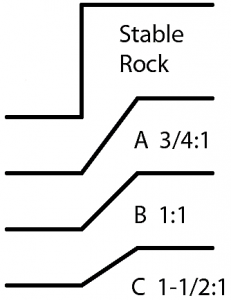
| Soil Classification Chart | |
| Soil Type | Description |
| A | Cohesive soils with an unconfined, compressive strength of 1.5 ton per square foot (tsf) (144 kPa) or greater. Examples of cohesive soils are: clay, silty clay, sandy clay, clay loam and, in some cases, silty clay loam and sandy clay loam. Cemented soils such as caliche and hardpan are also considered Type A. However, no soil is Type A if: • The soil is fissured; or • The soil is subject to vibration from heavy traffic, pile driving, or similar effects; or • The soil has been previously disturbed; or • The soil is part of a sloped, layered system where the layers dip into the excavation on a slope of four horizontal to one vertical (4H:1V) or greater; or • The material is subject to other factors that would require it to be classified as a less stable material. |
| B | • Cohesive soil with an unconfined compressive strength greater than 0.5 tsf (48 kPa) but less than 1.5 tsf (144 kPa); or • Granular cohesionless soils including: angular gravel (similar to crushed rock), silt, silt loam, sandy loam and, in some cases, silty clay loam and sandy clay loam. • Previously disturbed soils except those which would otherwise be classed as Type C soil. • Soil that meets the unconfined compressive strength or cementation requirements for Type A, but is fissured or subject to vibration; or • Dry rock that is not stable; or • Material that is part of a sloped, layered system where the layers dip into the excavation on a slope less steep than four horizontal to one vertical (4H:1V), but only if the material would otherwise be classified as Type B. |
| C | • Cohesive soil with an unconfined compressive strength of 0.5 tsf (48 kPa) or less; or • Granular soils including gravel, sand, and loamy sand; or • Submerged soil or soil from which water is freely seeping; or • Submerged rock that is not stable, or • Material in a sloped, layered system where the layers dip into the excavation or a slope of four horizontal to one vertical (4H:1V) or steeper. |
| Soil classification can only be done by a competent person. | |