


| General Information | You must be trained and understand how to safely use a ladder before use. Inspect the ladder before use. Never use a damaged ladder. Tag the ladder “DO NOT USE” and report it to your supervisor immediately.  Ladders must be set up on firm, level, and stable surface. Access at the top and bottom of the ladder must be kept clear and free of trip hazards. Straight and extension ladders require non-skid safety feet. If it is necessary to place a ladder in a doorway, barricade the door and post warning signs. Review and follow manufacturer guidelines. Ladders must be rated as Type I or greater and be able to support the load applied to it. When handling material, consider using a boom lift or scaffold instead of a ladder. Do not paint or modify ladders, this includes drilling holes in any part of the ladder or frame. Keep ladders free of oil, grease, or other slippery substances. Ladders can only be used for their designed purpose. As an example, do not use ladders for skids, braces, workbenches, or scaffold plank supports. 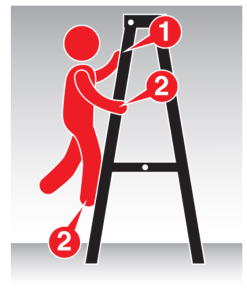 Do not carry anything in your hands when climbing up or down a ladder. Maintain at least 3 points of contact. If necessary, use a rope to raise tools or equipment to an elevated level. Face the ladder at all times. Portable metal ladders are not allowed. Keep your body within the rails of the ladder. Do not reach out too far.  For ladders 12 feet or more in length, two people are required to carry and move the ladder. When using a ladder near a leading edge, stairwells or other openings, fall protection may be required if the user cannot be protected from falling to a lower level while working on the ladder by other means. Use only manufacturer-approved devices or attachments on or with the ladder. Ladders shall not be used on scaffolds to increase the working level height of the user, except on large area scaffolds. |
| Step Ladders | Do not allow more than one person on a single-sided step ladder. Step ladders must be fully opened with the spreaders locked in place. A step ladder should never be leaned against a wall. Do not stand on or above the top rung. Follow the warning label for maximum working height. Do not straddle a ladder. Do not leave tools or material on the top cap of the ladder. Do not sit or stand on the top cap of the ladder. Only stand and climb on designated ladder rungs. Step ladders shall not be moved, shifted or walked in an attempt to move or relocate the ladder while it is occupied. For accessing another level, step ladder must extend at least three feet above the landing of the area being accessed. For accessing another level, step ladder must be secured to prevent tipping. |
| Straight and Extension Ladders | Do not set up ladders near live overhead powerlines. Set up ladders at a 4:1 ratio. 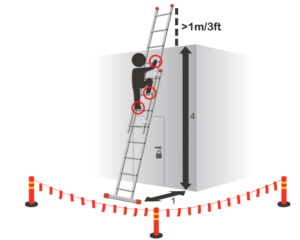 Ladders used to access an elevated level must extend at least 3 feet above the landing. If the ladder is going to be used for access, access should be corralled or guarded at the top. Secure ladder at the top and the bottom. If the ladder is being used for a short period of time, or while installing safety devices, it is not required to be secured at the top and bottom but can be held by someone at the base. Do not separate extension ladders. Maintain the rope and pulley system on extension ladders. Once the extension ladder is raised to the desired height, check to see that the safety latches are engaged. Maintain adequate overlap of extension ladder sections. Manufacturer requirements may vary, but generally require 3 or 4 rungs of overlap. Do not stand on the top 3 steps of an extension ladder. Landing platforms may be required when it is required to ascend heights more than 20 feet. |