
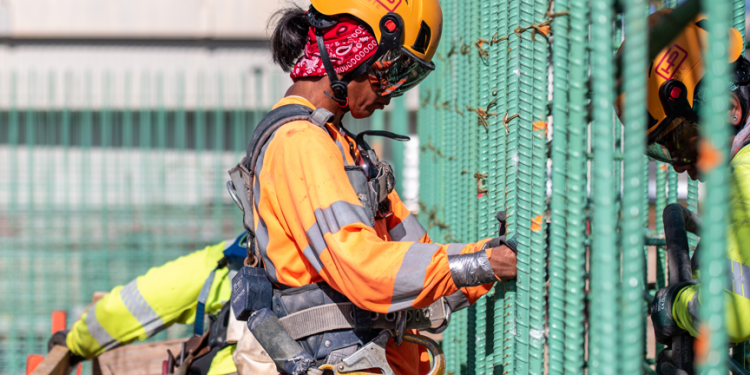

Fall protection is required when exposed to a 6 foot or greater fall. Please note that some facilities will require this at 4 feet (General Industry) so verify this with your supervisor.
| Required Fall Protection | • Roofs • Swing stages • Scaffolds • Ladders when used near shafts, over a guardrail, or adjacent to stairs • Formwork • Edge of slab • Floor or wall openings • Aerial lifts where tie-off is required by the manufacturer. See your supervisor for project requirements • Adjacent to hazardous equipment |
| General | Fall protection systems may include a guardrail system, safety net, personal fall arrest system, hole covers, or fall restraint system. You must receive training before using a harness, lanyard, or other type of fall protection system. If you have not received training or do not understand how to use your equipment, ask your supervisor. Inspect your fall protection equipment before each use. Never use damaged equipment. When storing your harness, lanyard, and other fall protection equipment, hang it in a secure location. Do not put it in the bottom of a gang box or anywhere else it can get damaged. |
| Anchorage Points | Must be able to hold at least 5,000 pounds per person attached. Ask your supervisor if you’re unsure about an anchorage point. Minimize freefall distance by placing your anchorage above you. Make sure you cannot contact a lower level in the event of a fall. Maintain at least 18 ½ feet of free fall distance when using a shock-absorbing lanyard. Side “D” rings are for positioning only (restricts fall to 2 feet or less). The rear “D” ring in the back is to be connected directly to a lanyard or self-retracting lifeline for 100% fall protection. Generally, back “D” rings can only have one snap hook attached to them at a time and should be positioned between your shoulder blades. 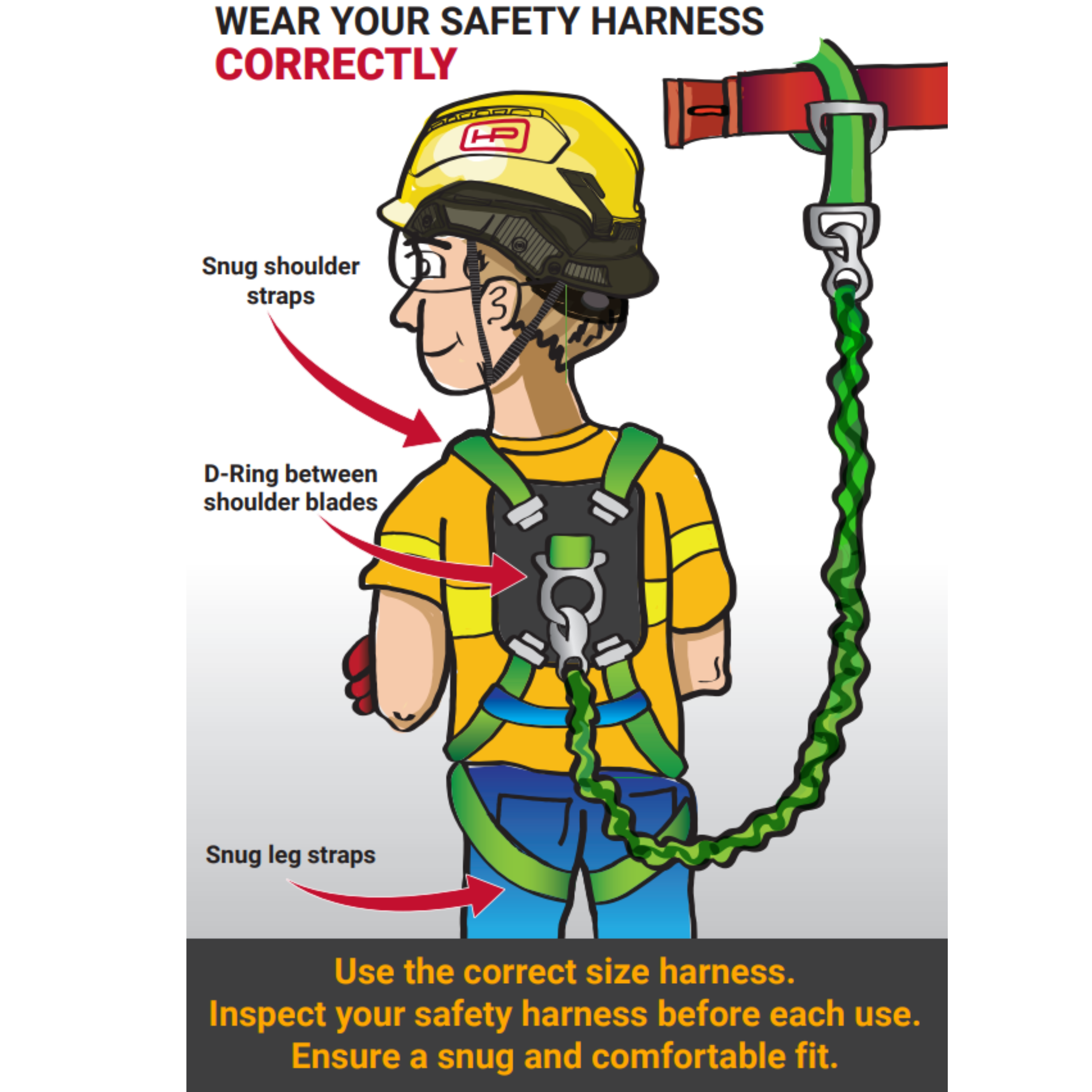 |
| Guardrails | Do not remove a guardrail without permission from your supervisor. Do not cross a guardrail without permission from your supervisor. You must wear additional fall protection equipment such as a harness and lanyard. Guard runways with a standard railing on all open sides four feet or more above ground level. Wherever tools, machine parts, or materials are likely to be used on a runway, a toe board shall be provided on the exposed sides. Top rails must be capable of supporting 200 pounds of force and midrails must be able to support 150 pounds of force. This generally requires a minimum of two fasteners (nails or screws) at each connection that are flush with the lumber. Guardrails must be 42 inches high (+/- 3 inches) with a midrail between them. 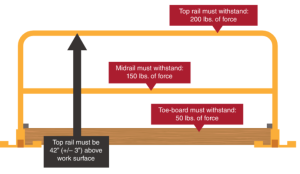 Wooden guardrails must be constructed with lumber free from knots, cracks, and splinters. Ensure nails do not protrude out the back, sides or fronts to prevent punctures, lacerations or snagging of clothing. 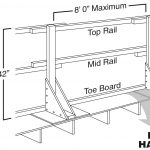 |
| Holes and Openings | All holes or openings 2 inches or more in their least dimension, in a floor, roof, or other walking or working surface will be provided with a cover, guardrail, or equivalent protection. Please note that some facilities (General Industry) may require protection at 1 inch or greater. Avoid driving over any hole cover with equipment. |
| Hole Covers | Covers must be cleated, wired, or otherwise secured so they cannot be displaced horizontally beyond the hole. Openings large enough for a person to fall through must have a secure cover using fasteners or other equivalent protection to keep people from inadvertently picking up the cover. Openings that present a fall-through hazard must be labeled with our standard sign indicating a floor, roof, or wall opening. 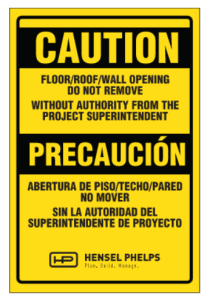 Hole covers must extend adequately beyond the edge of the hole. Covers must be able to support 2 times the maximum intended load. This includes personnel walking or working in the area, equipment, tools, and material. Do not remove a hole cover without permission from your supervisor. If you remove or alter a hole cover to perform work, you are responsible to protect the fall exposure prior to, during, and after work is completed. Never leave an open hole unattended. Skylights must be guarded by a standard skylight screen, fixed standard railing on all sides, or other acceptable method that is capable of withstanding 200 pounds. Note: California regulations may be more stringent. |
| Self-Retracting Lifelines | Connect the SRL directly to the “D” ring on your back. Avoid swing fall exposures by positioning the SRL properly. 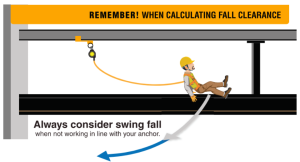 Read the SRL warning label to determine the proper use of the device. Examples include use in a vertical or horizontal position and work on leading edges. Minimize freefall distance by placing your anchorage above you. Make sure you cannot contact a lower level or sing into an adjacent structure in the event of a fall. |