
Safety Accountability for Everyone (SAFE)
| 1. | Recognize and encourage safe behavior. |
| 2. | Identify and correct unsafe behaviors and environmental conditions. |
| 3. | Inspect the work area before each operation and throughout the day. |
| 4. | Encourage open communication about safety concerns on the job. If you see something that you feel is unsafe, correct the situation immediately or notify your supervisor. Do not work in an unsafe condition or allow others to perform work in an unsafe manner. |
General Conduct and Disciplinary Policy
Hensel Phelps has rules and policies which serve as guidelines to acceptable behavior. Violation of these rules and policies may be subject to disciplinary action or termination. Examples of unacceptable conduct include sexual harassment, discrimination based on protected class, and violation of our substance abuse policy.
All employees are required to report any known or suspected violation of The company’s EEO & Anti-Harassment policy (Section PER 01.01.02). Foremen must report any situation that is in violation of the stated policy to the company EEO Officer (General Counsel), Human Resources, or their immediate supervisor, who will report it to the aforementioned company EEO Officer or Human Resources. You can also call the Corporate Hotline at 844.613.3109 to report your concerns.
Substance Abuse Policy
Hensel Phelps is firmly committed to providing its employees with a safe and productive work environment and promoting high standards of employee health. Accordingly, Hensel Phelps expects all its employees to report to work and be able to perform their duties productively and safely as set forth in Substance Abuse Policy (SPER 01.01.07). Drug and alcohol abuse by employees is regarded as unsafe by creating an increased risk to the safety of themselves, their fellow employees, and the general public. Therefore, drug and alcohol abuse in the workplace will not be tolerated and the company will take appropriate action to ensure compliance with this policy. All employees are subject to our substance abuse policy. Periodically, a project will be randomly selected for a substance screening. If you suspect a violation of our substance abuse policy, report it to your supervisor or foreperson immediately. You can also call the Substance Abuse Hotline at 800.826.6309 to report your concerns.
Work Clothing
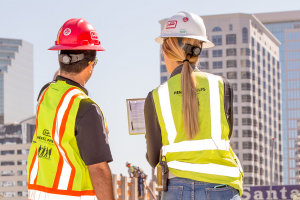
Appropriate clothing must be worn that meets our safety policy and is free from any symbol, word, or phrase that is a violation of our policies. The following clothing must be worn to work:
| Shirts | Must have at least a 4” sleeve length. Tank tops, muscle or fish net shirts are not allowed. |
| Pants | Long pants must be worn at all times. Pant legs must be long enough to cover the entire lower body from the waist to the ankle. Baggy or torn jeans and sweatpants are prohibited. |
| Loose Items | Do not wear clothing or jewelry which could get caught in machinery, moving parts, or otherwise cause an accident. Loose or torn clothing, and dragging pant cuffs, are examples of unacceptable clothing. |
| Hair | Long hair should be secured. |
| Footwear | Work boots are required at all times when on a construction site. Some projects require additional safety toe protection. Tennis shoes, loafers, sandals, and other non-construction rated footwear are not allowed on the site. |
| Uniforms | Some projects or positions may require a uniform. Uniforms must be kept neat and clean with no rips or fabric tears. |
Distractions
Stay focused on the task at hand. Avoid distractions during work that could take your attention away from your assigned work. Distractions that are not allowed on the project include, but are not limited to:
| 1. | The use of personal cell phones while working. |
| 2. | Radios, music players, portable TVs, headphones or earbuds. |
| 3. | Personal activities that distract from your job such as reading books. |
Written Programs
Available written programs include:
| Safety and Health Manual | Summarized in this Code of Safe Practices. |
| Accident Prevention Plan | Site-specific, developed for the unique nature of each project. Ask your supervisor to access the APP. |
| Injury and Illness Prevention Program (IIPP) | For projects in California under Cal/OSHA jurisdiction. Reviewed during New Employee Orientation and is available for review at any time. |
| Emergency Action Plan | Trained during site-specific safety orientation. includes the evacuation signal and where to assemble in the event of an emergency. |
| Emergency Phone Numbers | Posted on jobsite bulletin board. |
Activity Hazard Analysis (AHA)
Hensel Phelps develops an AHA for each operation performed on a project. This process identifies hazards associated with the operation and actions that will be taken to perform the work safely.
Your supervisor will review the AHA with you prior to assigning you to that operation. This review may be a formal review of the AHA or as part of a STA. If your supervisor has not explained the safe way to perform your assignment, stop and ask them for help.
Safety Task Assignment (STA)
Before assigning you a task, new or repetitive, your supervisor will conduct a STA with you. They will show and clearly explain the precautions that must be taken to perform the task safely. The STA encourages open communication to discuss safe work practices and hazard identification. Consideration should be given to access and egress, tools and equipment, material handling and safety conditions. If you have any physical limitations or are taking any medication that may prevent you from performing the assigned task, inform your supervisor immediately.
Accidents, Incidents, and Near Misses
All accidents, incidents, first aid cases and near misses must be reported to your supervisor immediately. An investigation of these events will be conducted with a focus on how to prevent recurrence. Employees will not be disciplined for reporting an accident, incident, or near miss.
If there is a serious accident, activate the project’s emergency action plan detailed in your safety orientation. Only employees that have been trained and authorized to perform CPR, first aid, or use an AED should attempt to perform these services.
Orderliness and Housekeeping
Proper housekeeping is important to maintain a safe and productive site. Keep your work area, passageways, storerooms, and service areas neat and orderly. Keep your tools and your work area clean as the job progresses. Additional site rules include:
| Waste Disposal | Put garbage, scraps, and other waste in the appropriate container. Do not allow items to protrude from the container that could injure someone walking by. |
| Smoking | Only allowed in designated locations. Place cigarette butts in designated containers. |
| Cords and Hoses | Keep cords and hoses elevated and out of access areas as possible. Never run extension cords across driveways or through doors unless they are physically protected from damage. |
| Work Area | Worktables should only have the tools and materials required to perform the job. Keep the floor of the work area free and clear of debris to avoid trip hazards. |
| Floors | Keep clean and dry. Where wet processes are used, drainage shall be maintained. False floors, platforms, mats, or other dry standing places shall be provided, where practicable. |
| Spills | Clean up grease and oil spills immediately using absorbent material. Place in appropriate container for disposal. |
| Materials | Material that could be blown over by the wind or accidentally shifted should be secured to prevent displacement. |
| Dunnage | Place material on dunnage to make material handling easier. 2x4’s and similar dunnage should be wider than it is tall to prevent tipping. |
| Storing Materials | Do not store tools or material on girders, ducts, lighting fixtures, beam flanges, ceilings, or other elevated locations. |
| Emergency Access | Do not block emergency egress (stairs, ramps, and doors), fire extinguishers, or emergency disconnect switches. |
Signage
| 1 | Read and follow warnings on signage placed around the project. |
| 2 | Install required signage before work begins and remove them once the task is complete. |
| 3. | If a sign is illegible, notify your supervisor. |
| Activities that require signage include: | |
| 1. | Laser use |
| 2. | Welding operations |
| 3. | Work in controlled access zones |
| 4. | Work with Powder-Actuated Tools |
| 6. | Work producing silica dust |
| 6. | Other hazardous locations and operations |
Work in Operating Facilities
| Minimize Impact | Review existing traffic path, both vehicular and pedestrian, and plan work to minimize impact. |
| Tools and Equipment | Select tools and equipment that minimizes or eliminates dust, gases and noise pollution outside work zone. |
| Storage | Only store material and equipment in a facility per approved plan. |
| Electrical | Be aware that existing facilities may have electrical panels with covers removed, loose, or with open panels. Only qualified personnel can work on electrical equipment. |
| Rotating Equipment | Be aware that guards on rotating equipment may be removed or loose. Inspect all rotating equipment in work area to ensure complete hazard analysis and operational planning. |
| Fire Protection Equipment | To have facility fire protection equipment taken out of service temporarily, including for test or drill, contact the Account Manager. This could include fire hydrants, fire lanes, sprinkler systems, or fire alarm systems. |